A 5-day Morocco itinerary realistically covers one region well, not the whole country. From Marrakech, five days is enough to cross the High Atlas, stand inside the kasbah at Ait Ben Haddou, walk the Todra and Dades gorges, and sleep a night in the Sahara at Merzouga. Adding Fes and Chefchaouen is possible, but it turns the trip into a driving itinerary — and you should decide that on purpose, not by accident.
Happy Morocco Travel is an Amazigh-owned Moroccan tour company based in Rissani, on the edge of the Sahara. Our family company, Tarhlaoui Transport Touristique, has been a registered tourist-transport business since 2006 (licence 190027) and we drive our own vehicles. The drive times below are the ones we actually record on these roads, not estimates copied from another guide.
Is 5 days enough for Morocco?
Yes, for one region. No, for the country.
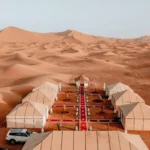
What five days comfortably covers: Marrakech and its medina, the Tizi n’Tichka pass over the High Atlas, the UNESCO ksar at Ait Ben Haddou, the Dades and Todra gorges, and a night in a desert camp at Erg Chebbi with a camel ride at sunset and sunrise.
What five days does not comfortably cover: Marrakech, the Sahara, Fes, Chefchaouen and the coast together. It can be driven — we sell that itinerary and people enjoy it — but you will be in the vehicle four to eight hours on every one of the five days. If your priority is time on the ground rather than distance covered, seven days is the honest number.
The three realistic 5-day routes
Almost every five-day trip in Morocco is one of these three. Pick by what you are willing to trade.
| Route | Best for | What you see | The trade-off |
|---|---|---|---|
| Sahara loop Marrakech out and back | First-time visitors. The default. | Marrakech, High Atlas, Ait Ben Haddou, Dades, Todra, Merzouga | One long return day (about 9 hours), and you retrace part of the route |
| Marrakech to Fes one-way | Travellers flying out of Fes | Everything above, plus the Ziz Valley, Ifrane and Fes medina | No backtracking, but two long driving days back to back |
| Marrakech to Fes and Chefchaouen | Set on seeing the blue city in one trip | All of the above, plus Chefchaouen and a Casablanca or Tangier finish | Every single day is a driving day. Nothing gets more than a few hours |
The rest of this guide follows the Sahara loop, because it is the one we recommend to most first-time visitors. If you want the Fes or Chefchaouen versions, they are on our Morocco 5-day tours page.
The classic 5-day Morocco itinerary at a glance
Drive times are door to door with normal photo and tea stops. They are not motorway times — the Atlas passes are slow by design.
| Day | Route | Highlights | Driving | Overnight |
|---|---|---|---|---|
| 1 | Marrakech → Ait Ben Haddou → Dades Valley | Tizi n’Tichka pass, UNESCO ksar, Valley of Roses | 7–8 hours | Dades Valley |
| 2 | Dades → Todra Gorge → Merzouga | Gorge walls, Ziz palm groves, camel trek at sunset | 5–6 hours | Desert camp, Erg Chebbi |
| 3 | Merzouga day | Sunrise over the dunes, Khamlia, nomad families, 4×4 in the erg | Local only | Desert camp or Merzouga |
| 4 | Merzouga → Todra → Ouarzazate | Rissani souk if it falls right, Draa palmeries, film studios | 6–7 hours | Ouarzazate |
| 5 | Ouarzazate → Marrakech | Second crossing of the Atlas, argan cooperatives | 4–5 hours | — |
One local note that saves people a wasted detour: the Rissani souk runs on Sundays, Tuesdays and Thursdays. If your day four lands on one of those, say so when you book and we will time the drive to pass through it. It is a working market, not a tourist one — donkeys, dates, and the smell of the bread ovens.
Day 1 — Marrakech over the High Atlas to the Dades Valley
Leave early. Not because the road is dangerous, but because the Tizi n’Tichka pass deserves daylight and the light on the far side is best in the afternoon. The pass tops out around 2,260 metres and the climb out of Marrakech goes through Berber villages and argan trees most visitors never stop in.
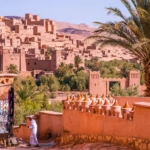
Ait Ben Haddou is the first proper stop. Parts of the ksar date to the 17th century, and yes, it has been a film set many times over — but walk up through it early or late and the film credits stop mattering. Allow an hour and a half to cross the river and climb to the top.
You finish the day in the Dades Valley, between red rock walls. Dinner is included at the Dades overnight.
Day 2 — Todra Gorge and into the Sahara
Todra is best before mid-morning, when the sun has not yet reached the floor of the gorge and the walls stay cool and blue. The road then runs southeast through the Ziz palm groves — hundreds of thousands of trees in a single valley — and the landscape empties out as you approach the dunes.
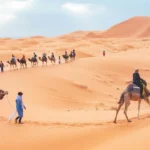
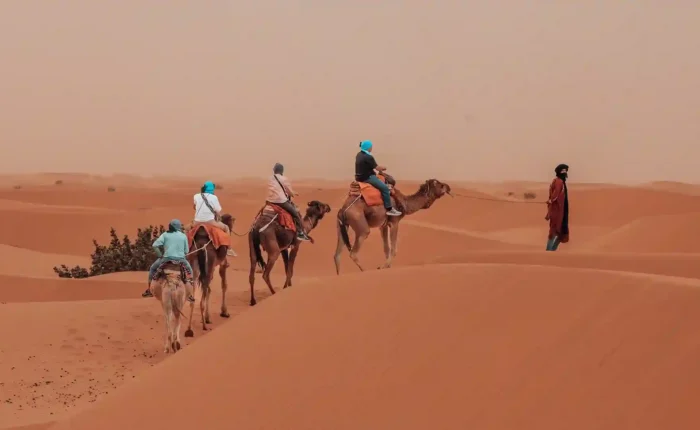
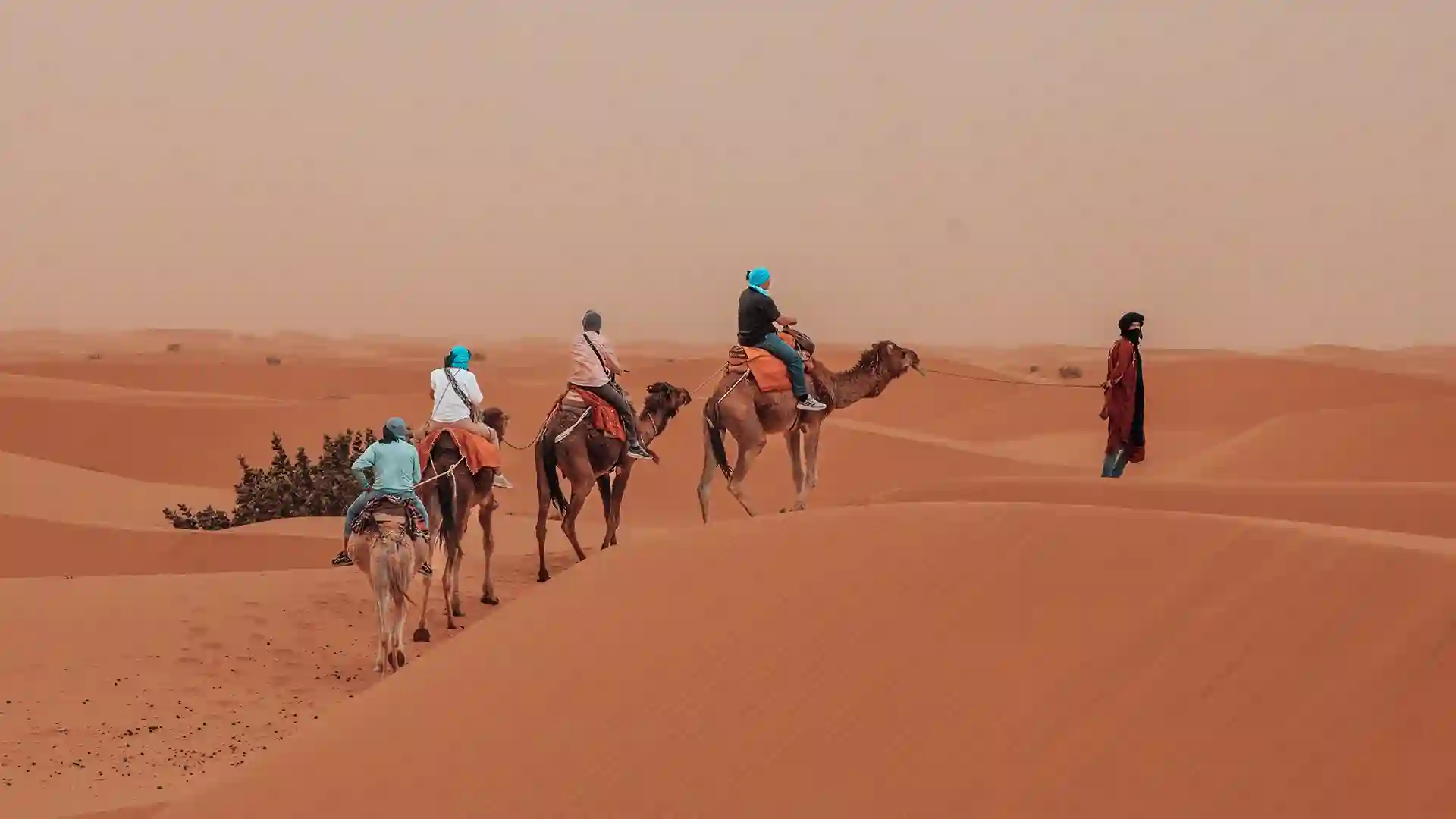
You reach Merzouga in the late afternoon. Camels leave for the camp about ninety minutes before sunset. If you would rather not ride, tell us and we will take you in by 4×4 instead; nobody should spend their first evening in the Sahara being uncomfortable. The full detail is in our guide to sunrise and sunset camel treks in Merzouga.
Day 3 — A full day in the desert
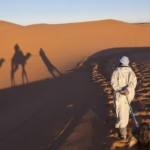
This is the day that justifies the drive. Get up for sunrise — it is cold before dawn from November to February, genuinely cold, and worth it anyway. The sand goes from grey to mauve to the deep orange Erg Chebbi is known for, and for a few minutes there is no sound at all.
The rest of the day is yours. Most people take a 4×4 into the erg to visit Khamlia, a village settled by descendants of Saharan families whose Gnaoua music is the real thing rather than a show, and stop at a nomad family’s tent for tea. Sandboarding is easy to arrange. So is doing nothing at all, which more people should choose.
If you want to understand what actually lives out there, we wrote an honest guide to the animals of the Sahara — most are nocturnal and most you will not see, but the tracks at dawn tell you they were there.
Day 4 — Back west through the gorges
You retrace part of day two, but the light is different and you stop in different places. If your timing lands on a Sunday, Tuesday or Thursday, Rissani’s souk is worth the pause — it sits on the ruins of Sijilmassa, the caravan city that made this corner of Morocco rich a thousand years ago.
The day ends in Ouarzazate. Dinner is included at the Ouarzazate overnight.
Day 5 — The second Atlas crossing
A shorter day than most itineraries admit, if you have overnighted in Ouarzazate rather than pushing all the way from Merzouga. Four to five hours back over the pass, with stops at the argan cooperatives on the descent, puts you in Marrakech by mid-afternoon — enough margin for an evening flight, though we would not book one before 7pm.
Can you really do Fes and Chefchaouen in 5 days?
You will read that it is impossible. That is not quite true, and we would rather give you the honest version.
It is possible. The route runs Marrakech → Dades → Merzouga → Fes → Chefchaouen → Casablanca or Tangier, and we operate it. What you are trading is not safety or comfort — it is standing-still time. Merzouga to Fes alone is seven to eight hours; Fes to Chefchaouen is another four. On that version you see Fes for part of a day and Chefchaouen for part of a morning.
So the honest rule: if Chefchaouen is a photograph you want, take the five-day version and accept the driving. If Chefchaouen is a place you want to sit in, give the trip seven days. We will tell you the same thing on the phone that we are telling you here.
How far you actually drive
The single thing that surprises visitors most. These are real road distances, not straight lines.
| Leg | Distance | Time with stops |
|---|---|---|
| Marrakech → Ait Ben Haddou | 180 km | about 4 hours |
| Ait Ben Haddou → Dades Valley | 160 km | about 3 hours |
| Dades → Todra Gorge | 65 km | about 1.5 hours |
| Todra → Merzouga | 200 km | about 3.5 hours |
| Marrakech → Merzouga (direct) | 560 km | 9–10 hours |
| Merzouga → Fes | 470 km | 7–8 hours |
| Errachidia airport → Merzouga | 126 km | about 1.5 hours |
That last line is the shortcut most people miss. Flying into Errachidia instead of driving from Marrakech removes the two longest days from a five-day trip and effectively buys you back a day and a half in the desert.
What changes the cost of a 5-day Morocco trip
We quote per trip rather than publish a fixed sticker price, because five variables move the number far more than anything else. Knowing them lets you steer your own budget.
- Group size. The largest single factor. The vehicle and driver cost the same whether two people or six are in it, so the per-person figure falls sharply as the group grows.
- Camp and hotel standard. Standard, comfort and luxury desert camps differ mainly in the bathroom. The sky above them is identical.
- Season. Spring and autumn are peak. Winter and high summer are quieter and cheaper.
- Route shape. A one-way finish in Fes or Tangier costs more than a Marrakech loop, because the vehicle has to come home.
- What you add. Guided city walks, cooking classes and 4×4 excursions in the erg are priced separately.
What is always included on our trips: private transport in our own vehicles, the driver, and breakfast every day. Dinner is included at the desert camp and at our Dades and Ouarzazate overnights. Entrance fees to monuments and museums are never included — we would rather say so here than surprise you at a gate. For an exact figure on your dates, write to us.
When to go
March to May and September to November are the two clean answers for this itinerary, because it crosses three climates in five days: city, mountain and desert.
Summer works if you accept that Merzouga passes 45°C and the desert activities compress into dawn and dusk. Winter is excellent for walking Marrakech and the gorges, but nights at Erg Chebbi drop close to freezing — visitors from Australia and the southern US consistently underpack for this. Month-by-month detail is in our best time to visit Morocco guide.
What to pack for five days
Pack for a fifteen-degree swing between afternoon and dawn, and pack light — you change hotel four times.
- Layers. A warm jacket or fleece for the camp and the pass, whatever the forecast says.
- A scarf. Sun, wind and blown sand. Buy one in Marrakech on day one; everyone does.
- Closed shoes for the gorges and the ksar, sandals for everything else.
- A small overnight bag for the camp, so your main case can stay in the vehicle.
- Cash. Card acceptance thins out fast south of the Atlas.
- A torch or headlamp. There is no light at the camp, which is the point.
Five mistakes we see on 5-day trips
Booking a flight out too early on day five. The Atlas crossing does not compress. Nothing before 7pm.
Trying to add Fes as an afterthought. Decide it at booking, not on day two. It changes every subsequent overnight.
Underestimating the cold. More people are uncomfortable at night in the Sahara than are uncomfortable in the heat.
Treating day three as a spare day. It is the reason you drove all that way. Do not schedule it as a travel buffer.
Trusting the map app over the driver. South of the Atlas the routing is frequently wrong, and it does not know which passes close.
Frequently asked questions
Is 5 days enough for Morocco?
Yes for one region, no for the country. Five days from Marrakech comfortably covers the High Atlas, Ait Ben Haddou, the Dades and Todra gorges and a night in the Sahara at Merzouga. Adding Fes and Chefchaouen is possible but puts you in the vehicle four to eight hours every day.
What is the best 5-day Morocco itinerary route?
Marrakech to Ait Ben Haddou and the Dades Valley, then Todra Gorge to Merzouga, a full day in the desert, and back west via Ouarzazate. It is a loop, so you return to Marrakech for your flight, and it gives the desert two nights instead of one.
Can you visit the Sahara desert in 5 days from Marrakech?
Yes, and it is the main reason to take five days rather than three. Merzouga is about 560 km from Marrakech, so you break the drive across two days each way and sleep at Erg Chebbi in between. Full detail in our guide on how to visit the Sahara Desert in Morocco.
Can you do Fes and Chefchaouen in a 5-day Morocco itinerary?
It can be done and we operate that route, but every one of the five days becomes a driving day. Merzouga to Fes is seven to eight hours and Fes to Chefchaouen another four. You would see Fes for part of a day and Chefchaouen for part of a morning. If you want to spend time in either, take seven days instead.
How much driving is in a 5-day Morocco itinerary?
On the Sahara loop, roughly 7 to 8 hours on day one, 5 to 6 on day two, local driving only on day three, 6 to 7 on day four and 4 to 5 on day five. Total road distance is about 1,200 km. The Atlas passes are slow, so distance and time do not scale the way they would at home.
What is the best time of year for a 5-day Morocco trip?
March to May and September to November. This itinerary crosses city, mountain and desert in five days, so you want the shoulder seasons when all three are comfortable. Summer pushes past 45°C at Merzouga; winter nights in the dunes drop close to freezing.
Do you need a guide for 5 days in Morocco?
You need a driver more than a guide. The value is in the road: knowing which passes are slow, where to stop, and how to time Todra and the dunes for light. We drive you ourselves and arrange licensed local guides for the city walks in Marrakech or Fes, where a specialist is genuinely better than a generalist.
Should you fly into Marrakech or Errachidia for a 5-day trip?
Marrakech if you want the city and the Atlas crossing. Errachidia if the desert is the whole point — it sits 126 km from Merzouga, about 90 minutes, and skipping the two long transfer days effectively gives you back a day and a half in the Sahara.
Anything here you want adjusted — more desert, less driving, a different finish — tell us and we will say honestly whether five days can carry it. Every other guide we have written is indexed in our Morocco travel guide. You can also see the ready-made versions on our Morocco 5-day tours page or the whole range at Morocco tours. And when you reach Rissani, the first glass of mint tea is on us.
Still working this trip out?
We are a family who run tours out of Rissani, on the edge of Erg Chebbi. Ask us anything about what you have just read — dates, driving times, whether an itinerary is actually realistic. You will get a straight answer from us, not a sales call.