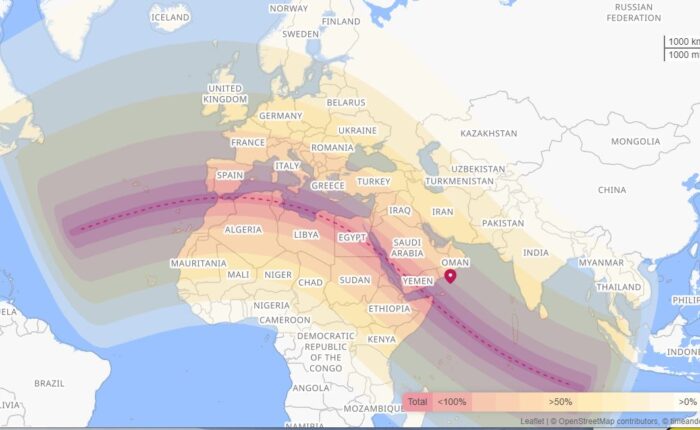
On Monday 2 August 2027, the Moon’s shadow crosses northern Morocco. Tangier, Tetouan, Chefchaouen, Al Hoceima and Nador sit inside the path of totality. Tangier gets 4 minutes 51 seconds of total eclipse, with mid-eclipse at about 09:47 Moroccan time. Everywhere else in the country — Fes, Rabat, Casablanca, Marrakech, the whole Sahara — sees a deep partial eclipse, not totality. If you want the black sun, you have to be north.
The honest part first. Happy Morocco Travel is an Amazigh-owned Moroccan tour company based in Rissani, on the edge of the Sahara — about 1,000 km of road from the path of totality. We are not going to pretend the dunes are the place to stand that morning. They are not. What the desert is good for is the ten days on either side of the eclipse, and that is the trip most people are really planning: five minutes of totality in the north, then the country.
What actually happens on 2 August 2027
This is the long one. Totality reaches 6 minutes 23 seconds at its maximum, in the Egyptian desert southeast of Luxor — the longest total solar eclipse over easily reachable land this century. Nothing longer happens until 3 June 2114.
The shadow track is up to 258 km wide. It comes in off the Atlantic, crosses southern Spain and Gibraltar, clips the northern tip of Morocco, then runs east through Algeria, Tunisia, Libya and Egypt before ending over Saudi Arabia, Yemen and Somalia. Greatest eclipse is at 10:07:50 UTC.
Morocco’s share is the Tangier peninsula, the Rif, and the Mediterranean coast out to Nador and the Algerian border. It is a narrow slice of the country, and it is the only slice that counts.
Where the path of totality crosses Morocco
All times below are local Moroccan time (UTC+1). Morocco stays on UTC+1 through the summer, so you do not need to do clock arithmetic on the day — but check any foreign eclipse site carefully, because several publish these times in UTC, one hour earlier.
| Place | Totality | Mid-eclipse (local) | Notes |
|---|---|---|---|
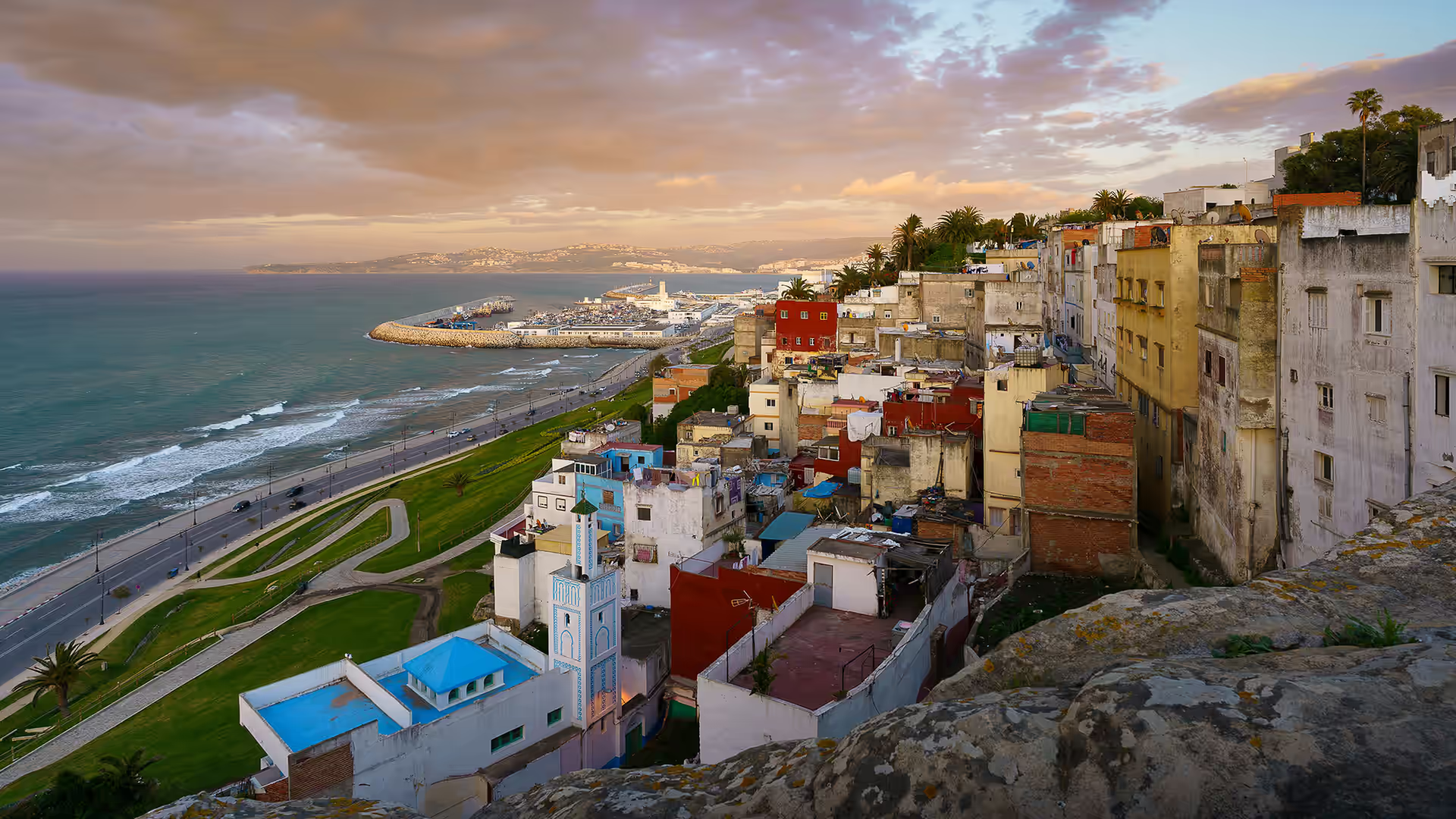
| Tangier | 4 min 51 sec | 09:47 | Totality roughly 09:44:47 to 09:49:38. Airport, ferries, hotels — the easy option, and the busiest |
| Tetouan & Martil | about 4 min 53 sec | 09:47 | Close to the longest duration in the country |
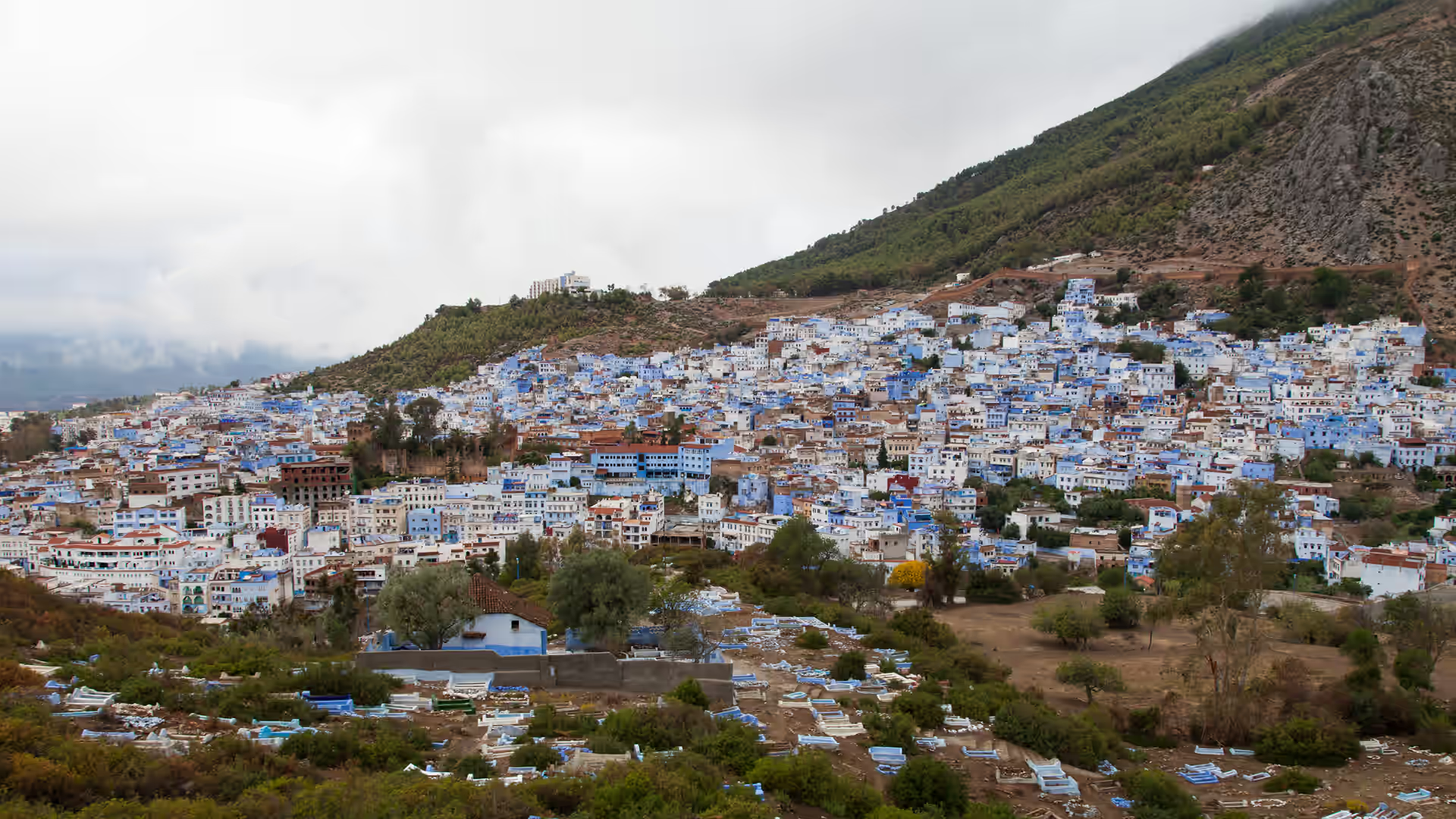
| Chefchaouen | about 4 min 14 sec | 09:46 | Inland and high — better cloud odds than the coast |
| Al Hoceima | roughly 4 min | about 09:48 | Inside the path, on the Mediterranean — confirm your exact spot |
| Nador | about 4 min 16 sec | 09:49 | Eastern Mediterranean coast |
| Oujda | 1 min 5 sec | 09:51 | Right on the southern edge of the path. Do not plan around it — drive north |
In Tangier the partial phase opens at about 08:40, the sky goes dark just before 09:45, and the last bite leaves the Sun at around 11:00. The whole event runs two hours and twenty minutes; the part you came for lasts under five.
Oujda deserves the warning it gets in that table. One minute of totality means you are sitting near the edge of the shadow, where a modest positioning error — or a low hill in the wrong place — costs you the eclipse entirely. Everything worth watching happens between Tangier and Nador.
What the rest of Morocco sees
A partial eclipse. A very deep one in the north, a merely impressive one in the south. The figures below are the maximum fraction of the Sun’s diameter covered by the Moon.
| City | Maximum coverage | Mid-eclipse (local) |
|---|---|---|
| Rabat | 98.1% | 09:45 |
| Fes | 97.9% | 09:47 |
| Meknes | 97.5% | 09:46 |
| Casablanca | 96.8% | 09:44 |
| Marrakech | 90.2% | 09:43 |
| Ouarzazate | 87.6% | 09:44 |
| Agadir | 86.5% | 09:41 |
| Merzouga & the southeast | roughly 90% | about 09:45 |
Here is the thing nobody tells you until afterwards: 98% is not almost a total eclipse. It is a different event. With a sliver of the photosphere still showing, the landscape stays lit, the corona never appears, and the horizon never turns that strange 360-degree sunset colour. Fes, at 97.9%, is a short drive from an experience it will not have. Totality is a step change, not the top of a scale — which is why people fly between continents for five minutes of it.
The weather question, which matters more than the duration
Northern Morocco in early August is hot and mostly clear inland. The coast is a different story, and this is where the eclipse gets decided.
Historical records for 2 August show the pattern plainly. Tangier has been cloudy on that date in about 42% of the years since 2000; Rabat 46%, Casablanca 50%. Move inland or south and the numbers collapse: Fes 5%, Meknes 6%, Oujda 7%, Ouarzazate 7%, Marrakech 3%.
The culprit is marine stratus. Cool water offshore, a nightly temperature drop, and a low sheet of cloud forms over the sea and drifts onto the land before dawn. It usually burns off during the morning — but mid-eclipse is at 09:47, which is early, and the eclipse itself cools the ground and can pull the fog back in. On the Mediterranean side the Rif traps onshore flow, so stratus lingers longer between Tetouan and El Jebha. Melilla averages only 61% of its possible sunshine in August. Across the Moroccan track as a whole, the climatological cloud fraction sits around 0.20 to 0.30, and the Gibraltar and Alboran area is the cloudiest stretch of the entire western half of this eclipse.
What we would do: sleep in Tangier, Tetouan or Chefchaouen, and treat eclipse morning as a drive, not a location. Moving 70 km inland — the ground rising south of the Rif, the Ouezzane corridor, the hills behind Tetouan — changes the odds dramatically, and you can make that decision at 06:00 with a satellite image in your hand. Chefchaouen is the one place that gives you inland air, altitude, and four and a quarter minutes of totality without moving at all. Avoid the coastal strip near Asilah, Larache and Souk el Arbaa, where the stratus sheet can push up to 100 km inland.
That flexibility is the whole argument for having a driver who knows the roads. On eclipse morning you do not want to be reading a map in an unfamiliar rental car while a cloud bank sits on your horizon.
Turning five minutes into a trip
The eclipse is a Monday morning in August. Nobody flies to Morocco for a Monday morning. The question is what the other twelve days look like, and there are two sensible shapes.
North first, then everything. Fly into Tangier, spend the eclipse in the Rif, then run south: Fes, the Middle Atlas cedars, the Ziz valley, Merzouga and the Erg Chebbi dunes, the Todra and Dades gorges, Ait Ben Haddou, over the Tizi n’Tichka into Marrakech. That is a 12- to 14-day trip and it uses the eclipse as the opening scene rather than the whole film.
North only. Tangier, Chefchaouen, Tetouan, Fes, maybe Meknes and Volubilis, and back out. Six or seven days, no long transfer, and you stay in the cooler half of the country in the hottest month.
Approximate driving times on these roads — measured on our own vehicles, not copied:
| Leg | Distance | Driving time |
|---|---|---|
| Tangier → Chefchaouen | 115 km | about 2 hours |
| Chefchaouen → Fes | 200 km | about 3 hours 30 |
| Tangier → Fes (motorway) | 300 km | about 3 hours 30 |
| Fes → Merzouga | 470 km | 7 to 8 hours — split it at Midelt or Errachidia |
| Merzouga → Dades Valley | 330 km | about 5 hours |
| Dades → Marrakech | 360 km | about 6 hours 30 over the Tizi n’Tichka |
One caveat we owe you: early August is the hottest week of the Moroccan year in the south. Merzouga runs 43–45°C in the afternoon. Desert camps work — you ride at sunset, eat late, sleep under the stars when the temperature drops — but the middle of the day is spent indoors, and if that sounds miserable, put the Atlantic coast or the High Atlas after the eclipse instead. Our guide to Morocco in August is blunt about which regions are pleasant and which are an endurance test, and the best time to visit Morocco guide has the month-by-month picture.
Book earlier than feels reasonable
Two things collide on 2 August 2027, and only one of them is the eclipse.
Every summer, Moroccans living in Europe come home through Tanger Med in an organised transit operation that moves millions of passengers and hundreds of thousands of vehicles — and it peaks in exactly these weeks. Northern Morocco in early August is already the busiest, most fully booked corner of the country before a single eclipse chaser arrives. Then add an international astronomy crowd to a strip of coast with a finite number of hotel rooms.
A sane timeline:
- 18–24 months out (now): fix the region and lock accommodation inside or near the path. Serious eclipse groups book this far ahead, and the good places in Chefchaouen and Tetouan are small.
- 12 months out: flights. Tangier and Tetouan have limited international capacity; Fes and Casablanca are the fallback arrivals.
- 6 months out: decide the shape of the rest of the trip, and where you finish.
- 3 months out: buy ISO 12312-2 eclipse glasses and a solar filter for any camera. Do not leave this to a Moroccan pharmacy on 1 August.
- Eclipse week: pick two or three backup viewing sites within an hour’s drive, and watch the satellite images.
Eclipse morning, practically
- Glasses on for everything except totality. ISO 12312-2 certified, no exceptions, and the same goes for binoculars, telescopes and phone lenses — they need a filter over the front, not over your eye.
- Glasses off during totality. This is the one moment you look with your own eyes, and it is the entire point. Put them back on the instant the first bead of sunlight returns.
- Be parked 45 minutes early. Roads inside the path will be busy and the light gets strange in the final ten minutes. Do not be driving.
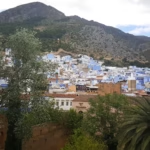
- Watch the ground, not only the sky. The temperature drops several degrees, birds go quiet, and in the last minute you may see shadow bands rippling across a pale wall — Chefchaouen’s blue lime-washed walls are about the best screen for that in Morocco.
- Expect a traffic jam afterwards. Everybody leaves at once. Plan a slow lunch instead of a 300 km transfer.
Frequently asked questions
Is the 2027 solar eclipse total in Marrakech?
No. Marrakech is outside the path of totality and sees a partial eclipse of about 90.2% at 09:43 local time. It will be a noticeably odd morning, but the Sun never disappears and the corona never appears. For totality you need to be in northern Morocco — Tangier, Tetouan, Chefchaouen, Al Hoceima or Nador.
What time is the solar eclipse in Morocco on 2 August 2027?
In Tangier the partial phase begins at about 08:40 local time, totality runs from roughly 09:44:47 to 09:49:38, and the eclipse ends around 11:00. Times shift by only a few minutes elsewhere in the country: mid-eclipse is 09:43 in Marrakech, 09:47 in Fes, 09:51 in Oujda. Morocco is on UTC+1 in August, so subtract an hour if a source quotes UTC.
Where is the best place in Morocco to watch the 2027 eclipse?
Tetouan and Martil have the longest totality at just under 4 minutes 55 seconds, and Tangier is a close second at 4 minutes 51 seconds with the best transport links. But the coast carries the highest cloud risk. Chefchaouen trades about 40 seconds of totality for inland air and altitude, which is a trade many experienced eclipse chasers will take. The strongest plan is to sleep in the north and stay mobile on the morning.
Will it be cloudy in northern Morocco on eclipse day?
It might be. Tangier has been cloudy on 2 August in roughly 42% of years since 2000, and the Gibraltar–Alboran area is the cloudiest section of this eclipse’s western track. The problem is marine stratus that forms overnight and usually clears during the morning — but mid-eclipse is early, at 09:47. Moving 70 km inland improves the odds substantially, which is why we build eclipse mornings around a vehicle rather than a viewpoint.
Can I see the total eclipse from the Sahara or Merzouga?
No. The Moroccan Sahara is far south of the path and sees roughly a 90% partial eclipse. We are based in Rissani, so we would love to say otherwise, but it is simply not where the shadow falls. The desert is the reason to stay another week, not the place to spend eclipse morning.
Do I need eclipse glasses in Morocco?
Yes, for every minute of the partial phases, wherever you are in the country. They must be ISO 12312-2 certified, and cameras, phones, binoculars and telescopes need a proper solar filter fitted over the front lens. The only safe moment for unaided eyes is during totality itself, and only if you are inside the path. Buy your glasses at home — do not count on finding certified ones locally.
Is August a good time to travel in Morocco?
It depends entirely on where you go. The Atlantic coast, the Rif and the High Atlas are pleasant. The interior is hot — Marrakech regularly passes 40°C and Merzouga reaches 43–45°C in the afternoon. Desert nights are fine and camps are built around sunset and sunrise, but midday is for shade. August is also peak domestic season in the north, so book early.
Should I choose Morocco, Spain or Egypt for this eclipse?
Egypt has the longest totality — 6 minutes 23 seconds near Luxor — and near-certain clear skies, but brutal heat and a narrow band of things to do around it. Southern Spain is easy to reach with similar duration to Morocco and its own coastal cloud risk. Morocco gives you about 4 minutes 50 seconds, a real cloud gamble on the coast that you can hedge by driving inland, and by far the best country to spend the following two weeks in. Choose Egypt for the eclipse; choose Morocco for the trip that contains one.
When should I book a 2027 eclipse trip to Morocco?
Now, if you want a room inside the path. Northern Morocco in early August is already at capacity because of the summer homecoming traffic through Tanger Med, and the eclipse adds an international astronomy crowd on top. Accommodation in Chefchaouen, Tetouan and Tangier is the constraint, not the flights.
Plan the trip around it
We build private itineraries with our own drivers and 4x4s — Tarhlaoui Transport Touristique, a registered Moroccan tourist-transport company since 2006, licence 190027. For 2 August 2027 that means something specific: a vehicle and a driver who can move you inland at dawn if the coast is under stratus, and an itinerary that does not fall apart because the eclipse morning went one way or the other.
Tell us which airport you can reach and how many days you have, and we will send back a route: talk to us about an eclipse trip. If you want to see the shapes first, our 10-day and 14-day itineraries are the ones that fit an eclipse start, the 7-day trips suit a north-only plan, and every route is drawn out on our Morocco travel maps page. The rest of our writing lives in the Morocco travel guide, including how to visit the Sahara and flights to Morocco.
Book the north for the eclipse. Come south afterwards — and when you reach Rissani, the first glass of mint tea is on us.
Eclipse circumstances calculated for each city from timeanddate.com and published path data; cloud climatology from Eclipsophile’s 2027 report. Times are local Moroccan time, UTC+1. Durations at the edge of the path change over short distances — confirm your exact viewing site before eclipse day.
Still working this trip out?
We are a family who run tours out of Rissani, on the edge of Erg Chebbi. Ask us anything about what you have just read — dates, driving times, whether an itinerary is actually realistic. You will get a straight answer from us, not a sales call.